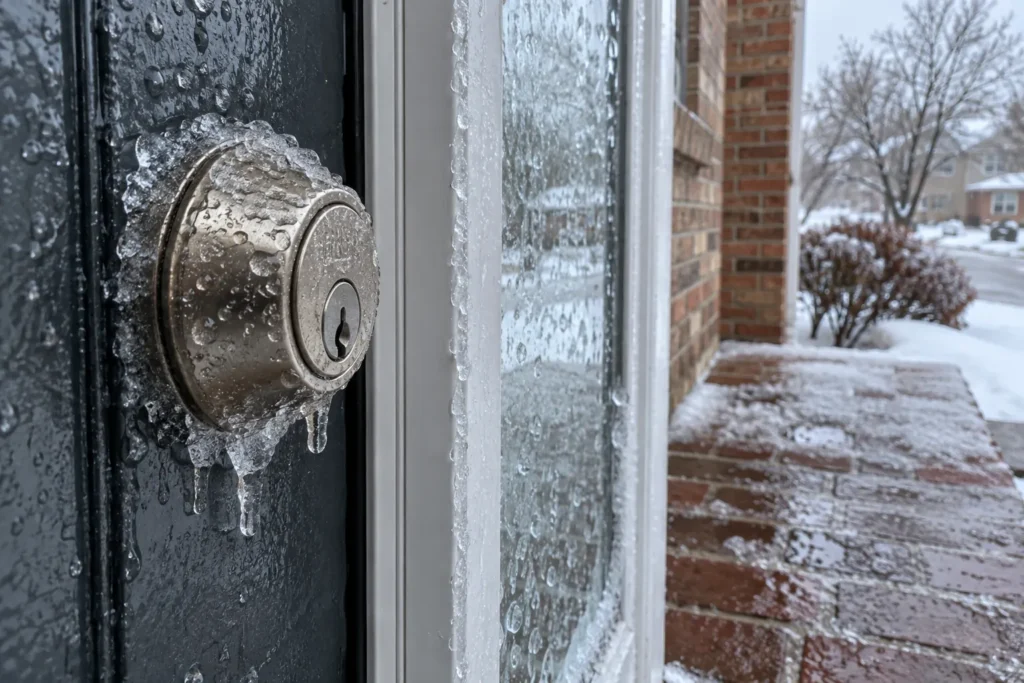
On a very cold morning the key will not go in, will not turn, or turns and the door still will not open. A frozen door lock is moisture that got into the cylinder and froze there, as Toronto Locksmith Shield, one of the five frozen-lock pages from locksmiths that we read, puts it. This guide is for anyone in Canada whose house or apartment door is stuck that way. It covers who to call, what the call can cost and what to ask first. For tenants, it also covers what the tenancy pages of British Columbia, Ontario and Quebec say about faulty locks.
It does not cover how to thaw a lock or get past one yourself. Pages that do are easy to find, and the locksmith pages we read warn that some of the usual tricks make the problem worse. If someone inside the building needs help, call 9-1-1 before you call about a lock. A car door is a different job and is not covered here. For a house door you cannot open for any other reason, start with our guide to being locked out of a house.
The short version: If you are outside, get somewhere warm first. Health Canada says to look for shelter when you are caught in extreme cold. Then do not lean on the key and do not use hot water on the lock; locksmith pages warn against both. If it is still stuck, call a locksmith and ask for the call-out fee, the labour rate and the after-hours rate before anyone drives over. No page we read prints a price for freeing a frozen lock, so the total has to come from your call. If the lock freezes again every cold snap, the cause may be the lock or the door, and a tenant can start by telling the landlord in writing.
Locked out right now? Start with our locked out now page. The method behind the businesses we list is public: read how we check what we publish.
Get out of the cold before you do anything else
The wait is the part of a frozen lock that can hurt you. The Government of Canada’s wind chill page (modified 16 December 2025) says that at a wind chill of -28 to -39 any exposed skin can freeze in 10 to 30 minutes, and at -40 to -47 in 5 to 10 minutes. It also notes that in sustained winds over 50 km/h, frostbite can occur faster than indicated.
| Wind chill | Time for exposed skin to freeze, per the Government of Canada page |
|---|---|
| -28 to -39 | 10 to 30 minutes |
| -40 to -47 | 5 to 10 minutes |
| -48 to -54 | 2 to 5 minutes |
| -55 or colder | Less than 2 minutes |
Health Canada’s extreme cold page (page details show 19 October 2021) says: “If you are caught in a severe snowstorm, or outside in extreme cold conditions, look for shelter.” It lists shivering and numb hands as the first stage of hypothermia, and says severe cases need immediate medical attention: call 9-1-1 or your local emergency number.
A neighbour’s home, a shop or a cafe will do. Once you are warm, you can make the calls below without hurrying into a price you have not checked.
Match the problem to the call
A frozen lock is one of several different problems, and each has its own first call. Find yours in the table.
| What you see | Who to call first | What the sources say |
|---|---|---|
| The key will not go in, or goes in and will not turn | A locksmith, once you are somewhere warm. A tenant should also tell the landlord or property manager. | Toronto Locksmith Shield says moisture that enters the cylinder and freezes “can lock everything in place”. The price section shows what a call can cost. |
| The key turns but the door will not open | A locksmith for the lock, and a door or carpentry trade if the door has shifted. Our door latch repair guide covers latch and strike work. | Capital Locksmith says: “The door itself sticks in the frame, so the bolt and strike no longer line up cleanly.” |
| Part of the key has snapped inside | A locksmith. Our key stuck in a lock guide covers the key side. | Capital Locksmith names a snapped key as the way a small problem becomes a bigger bill (see the next section). |
| It froze once and works now | Possibly none. Read the section on a lock that keeps freezing. | Capital Locksmith says many locks that seize each winter need care, not replacement; the section on the next cold snap has its wording. |
| It freezes each time the temperature drops | A locksmith to assess the lock, a door trade for the fit, and the landlord first if you rent. | Can-Lock Security says repeated freezing is “worth having assessed”. Ben’s Lock & Security says the cylinder may be worn or the door out of plumb. |
Three things that turn a frozen lock into a repair bill
Locksmith pages agree on what to avoid, and the reason they give is cost. None of this is a method for opening a door. It is the short list of habits that, by the pages’ own account, make the bill larger.
Leaning on the key
Capital Locksmith in Ottawa (page dated 10 September 2026) calls cranking hard on a key that will not turn “the single most expensive winter lock mistake”. Its reason: “Snap a key off inside the lock and a five-minute thaw becomes an extraction and possibly a new cylinder.” Can-Lock Security in Ottawa (page dated 11 August 2026) tells readers to resist the urge to lean on the key. Toronto Locksmith Shield (page dated 26 October 2025) says that leaning on the key or pouring hot water over the lock “usually causes more harm than good”.
The pages write about a key that will not turn. A key that will not go in at all is the same situation, so do not push it either; call.
Hot water
Capital Locksmith says never to pour hot water on the lock, because it “thaws for a moment, then refreezes deeper and worse, and can crack a cold cylinder”. Ben’s Lock & Security in Waterloo (page dated 3 December 2025) says to “skip boiling water” because “it refreezes and can damage finishes”. Super G&R Locksmith in Calgary (page dated 15 August 2025) adds a second item to avoid: “don’t try to heat your key with a lighter or pour hot water into the lock”.
Oil sprays
Two pages warn against oil-based products on a lock. Capital Locksmith: “Avoid oil-based sprays on locks, since they can collect grit and stiffen when the temperature drops.” Toronto Locksmith Shield: “Avoid WD-40 or grease, which can gum up and trap dirt.” Toronto Locksmith Shield suggests “a graphite or silicone-based lubricant in late fall” instead, and Super G&R Locksmith says that “graphite or silicone-based lubricant helps prevent freezing and keeps things moving smoothly”.
What a frozen-lock call can cost
No locksmith page we read for this guide prints a price for freeing a frozen lock. Of the five frozen-lock pages, four print no dollar figure at all. The fifth, Toronto Locksmith Shield, has one in a side block outside its article text: “the average cost is 120$ to open a door”. It does not say whether that covers a frozen lock. So the total has to come from your call.
The nearest published lines are a lockout, a service call, an after-hours rate, a repair and a new lock. Three other firms publish some of them on separate price pages, and the table sets them side by side.
| Line on the bill | Vancouver: Safe & Secure Locksmith, no date shown | Toronto: Matrix Locksmith, updated 3 September 2026 | Calgary: Calgary Rekey Lockworks, modified 17 August 2024 |
|---|---|---|---|
| Home lockout, standard hours | $80 to $160 | $70 to $220, depending on the lock type | $75 to $150 |
| Service call or fee | $75 in standard hours | $35 to $90, which the page says the lockout range does not include | $90 to $175, depending on the time of day; the page says this is just for driving to the service area |
| After hours | Labour starts at $150 between 5 pm and 9 pm. From 9 pm to 8:30 am it is $250 an hour. The page says after-hours labour is on top of the standard price overnight and at weekends. | $60 to $119 between 6 p.m. and 7 a.m. | May cost more, no amount stated |
| Labour | Not listed | Not listed | About $125 an hour, “billed on quarterly installments after the first half hour” |
| Damaged lock repair | Not listed | $80 to $170 | Not listed |
| Replacing a lock | Not listed | $90 to $260 | $100 to $200 per lock, listed as lock installation |
| Frozen lock | Not listed | Not listed | Not listed |
How to read the table
Read it as three separate price lists, not one market. The dates differ, and the Safe & Secure page shows none, so read it as of 13 October 2026. Every figure is what the firm publishes, not something we verified, and none of the three pages says whether tax is included. Not listed means the line is not on the page we read.
Matrix’s page (updated 3 September 2026) also gives wider ranges in a summary section, $80 to $200 for repair and $120 to $400 for replacing residential locks. It states its rates a second time: “standard rates start at $35 during regular hours and $119 after hours”. The table therefore shows only part of what that page says. For the wider picture of what Canadian locksmiths publish, see our guide to locksmith costs in Canada.
What this means for a frozen lock
No source says which of these lines a frozen-lock job uses. Read as a menu, freeing a lock might draw on the call-out fee and labour, a snapped key or a worn cylinder would bring in a repair or a new lock, and a door that has shifted is a different trade. Ask which of those you are being quoted for.
What to ask before anyone drives over
Ask these before you agree to a visit, and ask them of every company you call. If the frozen door is a shop or condo entrance, tell the property manager or condo board first; the call may be theirs to make.
- What is the total for a frozen lock at this hour, whether the key will not go in or will not turn, with the call-out fee and any after-hours labour included? Can-Lock Security advertises an “Exact quote before we dispatch”, and any company can be asked for the same.
- Is there a minimum charge, and in what steps is labour billed after it? Calgary Rekey Lockworks prints its labour as “billed on quarterly installments after the first half hour”, which leaves the steps for you to ask about.
- Is tax on top? None of the three price lists above says.
- If the key has snapped or the cylinder is worn, will you tell me the price of the repair or a new lock before you start?
- Does the visit include looking at why it froze? Toronto Locksmith Shield says its technicians “inspect the entire locking system, clean out hidden moisture or debris, and rekey if needed”.
- Can I have an itemised receipt?
Licensing rules for locksmiths may differ by province, so ask whether a licence applies where you live; our licensing table shows which provinces license locksmiths. A registry listing shows that a company exists. It says nothing about what it will charge or how well it works. Our page on how we check sets out what we look up.
If the lock keeps freezing
A lock that freezes once is weather. A lock that freezes each time the temperature drops is telling you something, and the pages we read point to three places to look: the lock, the door and, for tenants, the landlord.
The lock itself
Ben’s Lock & Security says: “If a lock keeps freezing, the cylinder may be worn or the door is out of plumb.” Can-Lock Security says repeated freezing is “worth having assessed rather than treated as an annual inconvenience to just work around”. Super G&R Locksmith goes a step further: “winter isn’t always the problem, it just reveals existing issues.” It adds that it usually advises homeowners to get locks inspected every two years, which is one firm’s advice and not a rule.
The door
Moisture is not the only thing the cold changes. Ben’s Lock & Security says: “Cold weather contracts metal components while swelling wood and saturated weatherstripping.” Toronto Locksmith Shield says: “Gaps around doors let in cold air and moisture that can reach the lock.” Natural Resources Canada (Keeping the Heat In, section 8, modified 14 January 2025) says poor installation, years of hard use, shifting foundations and seasonal warping can often push hinged doors out of square with their frames, and advises: “If doors do not fit snugly, fix or replace the door, frame, hardware, gaskets and weatherstripping.”
If the key turns but the door stays shut, Capital Locksmith lists a sticking door as a separate cause: the bolt and strike no longer line up cleanly. A door that has shifted is a door job rather than a lock job, so ask a locksmith whether the lock or the door is the problem before you pay for a new lock. Our door latch repair guide covers what latch and strike work costs. Ben’s Lock & Security adds that “repeated thaw cycles can slowly pull screws out of softwood jambs” in its Waterloo-area service region.
Before the next cold snap
The time to deal with a lock that stuck last winter is before the next one. Capital Locksmith says many locks that seize each winter “just need cleaning, the right dry lubricant, and better weather protection around the door”. It suggests testing every exterior lock “in late autumn while it is still mild” and fixing any stiffness then. Our guides to changing locks and rekeying show what a new or reworked lock can cost if cleaning is not enough.
If you rent
The three provincial pages below put the repair of a faulty lock on the landlord. None of them mentions a frozen lock, so whether yours counts as a defect is a question for your landlord, your tenancy board or your lease. These are residential tenancy pages; a shop lease is a separate document, so read it and ask the property manager.
| Province and page | What it says about locks | What it tells a tenant to do |
|---|---|---|
| British Columbia: Repairs and maintenance, last updated 4 March 2026 | Among what a landlord maintains, the page lists “Locks on doors and windows” and “Devices that allow access to the unit”. An emergency repair must be urgent, necessary for the health or safety of people or property, and relate to an issue such as “Damaged or defective locks that give access to a rental unit”. | “Tenants must request repairs in writing: by email, letter or text message.” In an emergency, contact the landlord or their contact person. If there is no response, “Make two attempts to phone them at the emergency contact number given”. To claim the cost back, send “All receipts” and “A written summary of what happened”. |
| Ontario: Landlord and Tenant Board brochure, Maintenance and Repairs, last updated July 2018 | “A landlord must keep a rental property in a good state of repair.” Things the landlord provides “must be kept in working order”, and the brochure’s list includes “Windows, doors, locks, lighting”. | The first thing a tenant should do is “ask the landlord – in writing – to fix the problem”. |
| Quebec: Tribunal administratif du logement, Urgent and necessary repairs, no update date shown (read 13 October 2026) | Lists “Faulty locks on doors to the dwelling” among its examples of an urgent repair. | A tenant “must make every effort to get in touch with the lessor or their usual representative”, and should note the times and dates of the calls. The tenant can then “call a qualified person to perform the urgent repair, such as a plumber, an electrician or a carpenter”. “The lessor has to reimburse you for any reasonable expenses you are claiming.” |
Alberta’s tenancy page says the landlord is “responsible for keeping the rental premises reasonably safe and in good repair at all times” (published 5 August 2025). Saskatchewan’s repairs page says landlords “must maintain the rental premises in a good state of repair and fit for habitation, use and enjoyment”. Neither page says anything about repairing a faulty lock or about urgent repairs.
If the frozen door is a shared entrance, tell the building office or property manager. BC’s page says landlords of buildings with more than one rental unit “are responsible for maintaining the shared areas”, and lists “Locks and access devices (such as electronic fobs) for shared doors”. Whatever the province, write down who you told and when, and keep any receipts. If you are the landlord or property manager, the same pages set out the landlord’s repair duties.
What we could not establish
We could not establish which lines of a bill a frozen-lock job uses, or whether tax is included in any of the published prices. The three price lists come from three cities, so they are not a national price. The Calgary page was last modified in August 2024 and the Vancouver page shows no date, so prices may have changed.
None of the tenancy pages we opened says whether a lock that froze in the cold counts as faulty, or who pays for a call-out when the landlord cannot be reached. The Ontario brochure is dated July 2018 and the Quebec page shows no update date, so check the current rules with your tenancy board.
We opened tenancy pages for British Columbia, Ontario, Quebec, Alberta and Saskatchewan. Rules elsewhere may differ. Our page on how we check says what we look up.
Frequently asked questions
Can I pour hot water on a frozen door lock?
Four of the five frozen-lock pages warn against it: Capital Locksmith in Ottawa, Ben’s Lock & Security in Waterloo, Super G&R Locksmith in Calgary and Toronto Locksmith Shield. Capital Locksmith says hot water thaws the lock for a moment, then refreezes deeper and worse, and can crack a cold cylinder. Ben’s says boiling water refreezes and can damage finishes, and Super G&R adds that a key should not be heated with a lighter.
How much does a locksmith charge for a frozen door lock in Canada?
We found no published price for freeing one. The nearest published lines are a home lockout and a service call. Matrix Locksmith in Toronto lists a lockout at $70 to $220 and a service fee of $35 to $90 on its page updated 3 September 2026, and these are published, not verified. Ask for the total, with the call-out fee, any after-hours labour and tax, before anyone drives over.
Do I need a new lock after it freezes?
Not necessarily. Capital Locksmith in Ottawa says many locks that seize each winter need cleaning, a dry lubricant and better weather protection around the door. Can-Lock Security says a lock that freezes repeatedly is worth having assessed.
Why does my door lock keep freezing?
Toronto Locksmith Shield says moisture from humidity, snow or condensation can enter the cylinder and freeze, and that gaps around doors let in cold air and moisture. Ben’s Lock & Security says that if a lock keeps freezing, the cylinder may be worn or the door out of plumb. Natural Resources Canada says to fix or replace the door, frame, hardware, gaskets and weatherstripping if the door does not fit snugly.
Who pays for a frozen lock if I rent?
We could not establish that. The British Columbia, Ontario and Quebec tenancy pages we read cover faulty or defective locks, and none mentions a frozen one. British Columbia’s page says tenants must request repairs in writing, so tell your landlord in writing and keep any receipts.
What if I cannot get a locksmith tonight?
Stay somewhere warm. Health Canada says to look for shelter if you are caught outside in extreme cold, and to call 9-1-1 for severe signs of hypothermia. Then phone more than one company and ask each for its earliest visit and whether that is at standard-hours or after-hours rates. If you rent, British Columbia’s page says to make two attempts to phone the landlord’s emergency contact. Quebec’s page says a tenant who cannot reach the lessor can call a qualified person for an urgent repair and claim reasonable expenses back.
What to do now
Get warm, then call. Ask for the total with the call-out fee, any after-hours labour and tax before anyone drives over.
If you rent, send your landlord a written message today saying the lock is failing in the cold, and keep a copy; the BC and Ontario pages both say repair requests go in writing. The FAQ above covers what to do if nobody can come tonight.
Before the first hard freeze, test each exterior lock while the weather is mild. Capital Locksmith suggests doing it in late autumn and fixing any stiffness then.
Still locked out? Start with our locked out now page. To find a business you can check before you call, see frozen lock help across Canada or browse businesses by province. We look up each company in its provincial corporate registry and re-run that check monthly. We do not verify prices, and every listing shows the date the business last updated it.