You are standing beside the car with your thumb on the fob, pressing harder each time, then holding it up near your head because somebody once told you that helps. The doors stay locked. It is dark, it is cold, and the part that just failed is roughly the size of a nickel.
Almost every time, that part is a lithium coin cell worth about a dollar. What the next hour costs you depends on whether you work that out now, or after someone has already driven across town to tell you.
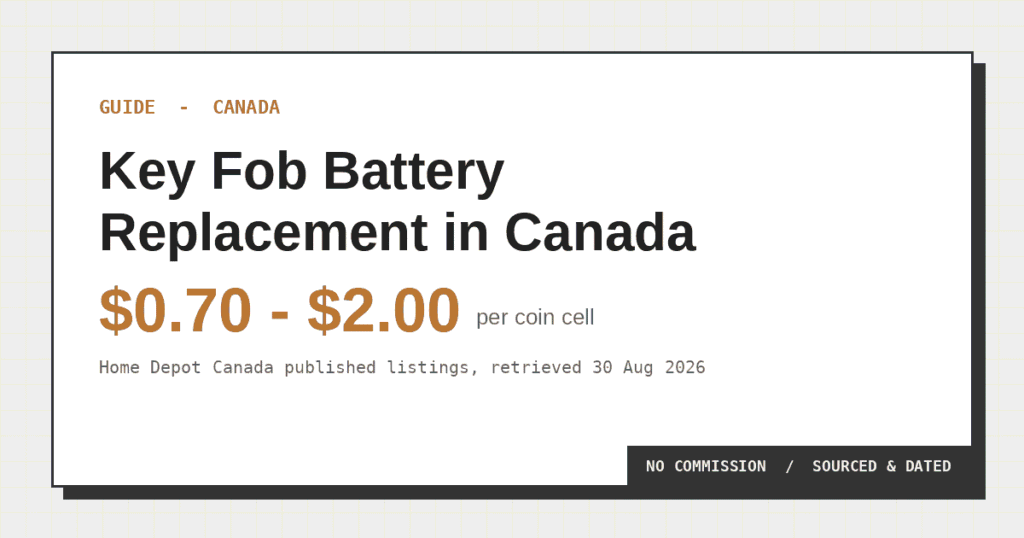
Short version: Most Canadian key fobs run on a 3 volt lithium coin cell. Home Depot Canada lists a four pack of Energizer CR2032 at $7.98 and a ten pack of the HDX equivalent at $6.98, which works out to roughly seventy cents to two dollars per cell (Home Depot Canada product pages, retrieved 30 August 2026). Cold is why these fail in December rather than July: Energizer rates the CR2032 for -30C to 60C (Energizer CR2032 product datasheet, form 2032NA0618, retrieved 30 August 2026). If a fresh cell of the right code does not bring the fob back, the problem is the fob or the vehicle, and that is a different job with a different bill.
Not sure the battery is the problem? Start from the provincial directory and read how we check listings before you phone anyone.
What the battery actually costs
The cell is the cheapest component in the whole failure. Two published listings from one Canadian retailer, read on the same day, show how much the price per cell moves with pack size alone.
| Product as listed | Pack | Published price (CAD) | Per cell | Source and date |
|---|---|---|---|---|
| Energizer 2032 Lithium Coin Battery | 4 | $7.98 | about $2.00 | Home Depot Canada, retrieved 30 Aug 2026 |
| HDX Lithium CR2032 | 10 | $6.98 | about $0.70 | Home Depot Canada, retrieved 30 Aug 2026 |
Per cell figures are the listed pack price divided by the pack size. These are one retailer’s listings on one day in one country, not a national average, and we do not verify retail pricing. Prices move. The point of putting them here is that you can click through and see the number yourself, which is more than most pages quoting a key fob battery price will let you do.
Buying the ten pack for less than the four pack costs is not a trick. It is the ordinary shape of coin cell pricing, and it matters because your fob is not the only thing in the house running on one of these. The bathroom scale, the car remote starter, the thermometer on the deck and the kitchen timer are all candidates.
Before you buy anything, read the code printed on the flat face of the old cell. CR2032 is the common one, but CR2025 and CR1620 turn up in plenty of fobs, and they are not interchangeable even when they look close. The digits are a size code, not a brand code. Match them exactly.
Why fobs die in December and not in July
Canadian interest in this problem roughly doubles between summer and the first week of December, then stays high through January before falling away in spring (Google Trends, key fob battery replacement, Canada, twelve months to 29 August 2026). That is not a coincidence of holiday driving. It is the cell hitting the edge of what it was built for.
Energizer rates the CR2032 for an operating range of -30C to 60C and a typical capacity of 235 mAh measured at 21C (Energizer CR2032 product datasheet, retrieved 30 August 2026). Read the bottom of that range against a January morning in Winnipeg, Regina or Edmonton and the margin disappears. A cell that has been quietly weakening for a year still has enough left to work in a warm pocket, and not quite enough to push out the short burst of radio the fob needs when it has been sitting outside overnight.
This produces the single most useful diagnostic in the whole topic. A fob that works indoors and fails in the parking lot is not fine. It is telling you the cell is close to done, several weeks before it strands you. Most people read that signal as the car being temperamental and wait.
How to tell the battery from a bigger problem
Three checks, none of which require a tool or a technician, will separate a dead cell from something that needs paying for.
Start with range. If the fob works at arm’s length from the door but not from across the driveway, and it used to work from across the driveway, that is a weakening cell. Then try the spare fob if you have one. A spare that works normally clears the vehicle and points at the first fob. Finally, warm the fob in a closed hand for a minute and try again. Getting one more press out of it in the cold is a strong sign that the cell, not the electronics, is at the end.
What comes next is the part worth being disciplined about. If you fit a fresh cell of the correct code and the fob is still dead, stop buying batteries. Either the fob itself has failed or the vehicle has lost its pairing, and neither is fixed with another coin cell. That is the territory covered in our guide to key fob replacement costs in Canada, where hardware and programming get quoted as one confusing number.
One more thing to read before you improvise. Your owner’s manual has a section on what to do when the fob battery is dead, and it is written for your exact model. Whether the fob is designed to be opened at all, whether there is a mechanical key in it, and whether the vehicle has a documented backup for starting are all model specific and all answered there. Guessing at it in a cold parking lot is how a two dollar problem becomes a broken fob housing.
The old cell is the actual hazard
This is the part the dealership blog posts leave out, and it is the reason to take the two minutes rather than leave the old battery on the kitchen counter.
A swallowed button battery can lodge in a child’s throat, where saliva triggers a current and a chemical reaction that, in Health Canada’s words, can burn through the esophagus in as little as two hours (Health Canada, Battery safety: Button batteries, last updated 26 November 2024). Health Canada records 125 button battery injuries reported through its injury surveillance program in 2020, against an average of 114 a year across 2016 to 2019 (Health Canada consumer alert, retrieved 30 August 2026). Key chains and remote controls are on Health Canada’s list of the everyday things these cells live in.
A used cell is not safe by virtue of being flat. Health Canada is explicit that even used or expired batteries can cause life threatening injuries, advises taping both faces with non conductive tape before disposal, and says never to store these near food or medicine. If you think a child or an adult has swallowed one, go to the nearest emergency department immediately rather than waiting to see whether symptoms develop.
So the honest version of the job is four steps, not one: check the code, fit the new cell, tape the old one, and get it out of the house. The last two take longer than the first two.
What you are paying for when someone else does it
The cell is a rounding error on any invoice. Everything above it is the visit: the travel, the shop’s time, being open at the hour you actually need them, and the risk the technician carries that it turns out not to be the battery at all.
We are not going to print a national figure for that, and you should be suspicious of pages that do. The only price worth anything here is one a specific business publishes, with a date, in your province. Where a shop publishes one, you can read it before you dial. Where it does not, the number comes from the phone call and nowhere else, which is why the questions below matter more than any figure we could print.
There are sound reasons to hand this one over. Some proximity fobs are sealed units that are not designed to be opened by the owner, and the manual will say so. A fob still inside its vehicle warranty is worth leaving alone. And if you have already replaced the cell without success, you are no longer buying a battery, you are buying a diagnosis.
What you should ask before anyone drives out:
- The all in price, including any after hours, weekend or statutory holiday surcharge
- Whether the battery is included in that number or billed on top
- What you pay if a fresh cell does not fix it
- Whether they can program a replacement fob if that is what it turns out to be, or whether that is a second call
- The legal business name, and the licence number in provinces that issue one
That last item comes with a caveat we would rather state than skip. Locksmith licensing requirements differ by province, so what there is to ask for depends on where you are standing. What we check on each listing, and how often we re-check it, is set out on how we check listings. If a business quoted you one figure and invoiced another, tell us so the entry can be corrected.
Frequently asked questions
Which battery does my key fob take?
The code is printed on the flat face of the cell already in it, and that code is the answer. CR2032 is the most common in Canadian fobs, with CR2025 and CR1620 close behind. Match the printed code exactly rather than the physical look, because two cells with the same diameter and different thicknesses will both sit in the housing and only one will make reliable contact.
Will changing the battery erase my fob’s programming?
Your owner’s manual is the authority for your model, and it is the section you want before you open anything. Some vehicles ask for a short resynchronisation step after a power interruption and some do not, and the manual states which yours is. If the manual is in the glovebox of the car you cannot open, most manufacturers publish it as a PDF on their Canadian site.
How long should a key fob battery last?
Long enough that you will not remember the last change, which is exactly the problem. Rather than tracking a date, watch the range. The distance at which the fob stops working is the honest gauge, and it shrinks gradually before it fails completely. Cold accelerates the last stretch, which is why the failure so often arrives in the first hard week of winter.
Is it cheaper to change it myself?
On price alone, yes, and it is not close. A cell is roughly seventy cents to two dollars from a published Canadian retail listing (Home Depot Canada, retrieved 30 August 2026), while any visit from a business carries a floor set by their travel and time. The case for paying someone is a sealed fob, an active warranty, or a fob that a new cell already failed to revive.
What do I do with the old battery?
Tape both faces with non conductive tape and keep it away from children and pets until it reaches a battery recycling drop off. Health Canada advises discarding used button batteries quickly and properly, and warns that used cells still carry enough charge to cause serious injury (Health Canada, Battery safety: Button batteries, last updated 26 November 2024). A loose coin cell in a junk drawer is the failure mode, not the battery in the fob.
Before you spend anything
Pop the old cell out and read the code on it. That one action decides everything downstream: whether you are buying a two dollar part on the way home, or booking a visit for a fob that has genuinely stopped working. Doing it in your kitchen at nine in the evening costs nothing. Doing it in a parking lot in February, after the fact, costs whatever the callout costs.
If the cell is not the answer, find the businesses covering your area in the provincial directory, and start with the ones whose pricing you can read before you call. Every guide we publish sits in the guides library.